
The 33 Vertebrae

If we can understand where bone is, what it looks like, and what it does, we can change the way we move the skeleton and, therefore, the dancing body.
When we take the muscle away, one of the first things we see is that movement of the bones central to our alignment happens at the vertebrae:
- Movement of the spinal column happens at the 33 vertebrae.
- Movement of the skull happens at its spinal column connection at vertebrae C1 and C2.
- Movement of the rib cage barrel happens at the thoracic vertebrae.
- Movement of the pelvic barrel happens at its connection to the sacral vertebrae (the sacrum) and its connection to the lumbar vertebrae.
Because Literal Technique is geeky and analytical, we are going to spend a lot of time in the world of the literal body, which is the “Geeky Glory” of Literal Technique. The Geeky Glory details the anatomy of the bone or muscle. I think the body is pretty amazing – glorious, in fact – and some might think my amount of detail is geeky, so this is my phrase for saying, yes, it is! It is a Geeky Glory!
If the What Happens Where shows us where movement actually happens, the Geeky Glory shows us how movement actually happens. Both of these eliminate guesswork. Guesswork will not improve your technique.
* * *
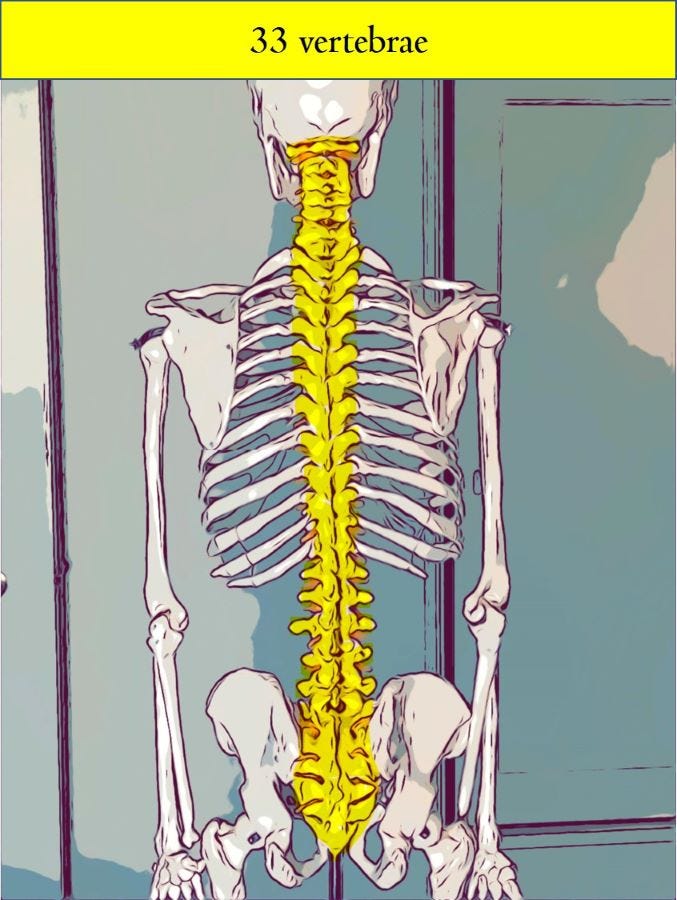
Understanding the neutrality of the spinal column (the vertebrae) begins with knowing what it looks like. The established method of talking about the spinal column divides it into regions, with each region having a specific number of vertebrae. Although this is useful when we are learning the anatomy, the spinal column is actually one structure with 33 vertebrae, and this is how Literal Technique approaches it.
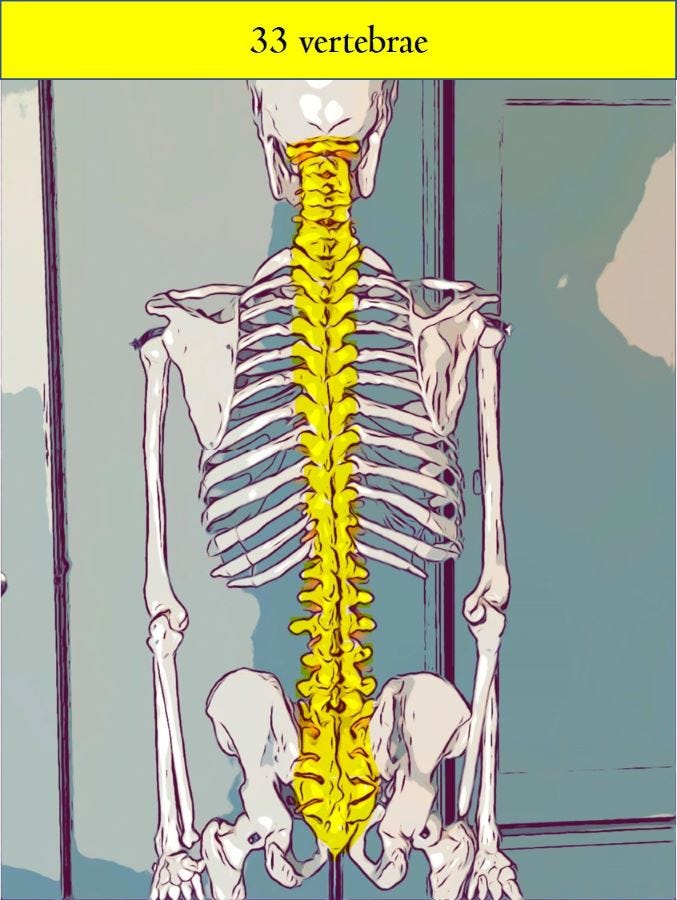
The vertebrae are conventionally referred to by a letter that corresponds to the established regions (C for cervical, T for thoracic, L for lumbar, and S for sacral), followed by a number for their respective vertebra. The numbers start at one and ascend as we move away from the skull and toward the tailbone. For example, the first thoracic vertebra is called T1 (closest to the cervical vertebrae) and the last thoracic vertebra (closest to the lumbar vertebrae) is called T12.
With that in mind, let’s take a look at the Geeky Glory of the 33 vertebrae. I’m going to start at the skull and work my way to the tailbone:
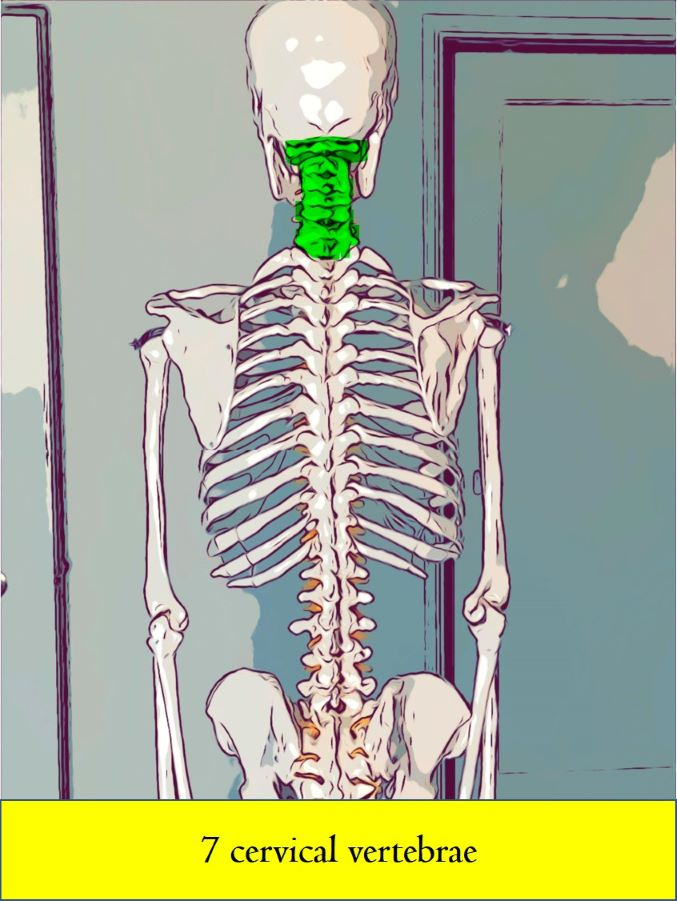
There are seven cervical vertebrae. The cervical vertebrae are inside the neck. As a group, the cervical vertebrae (also called the cervical spine) have an anatomical curve of ~20-35° into the body (called lordosis). An anatomical curve exists all by itself, so it is a starting point, not something we create with movement. The cervical vertebrae flex (~45°), extend (~70°), and rotate (~80°). The degrees of anatomical curve, flexion, extension, and rotation vary by person, which is why these degrees are approximate. The skull has a bone-to-bone connection to the 33 vertebrae at C1, which is directly below the skull.
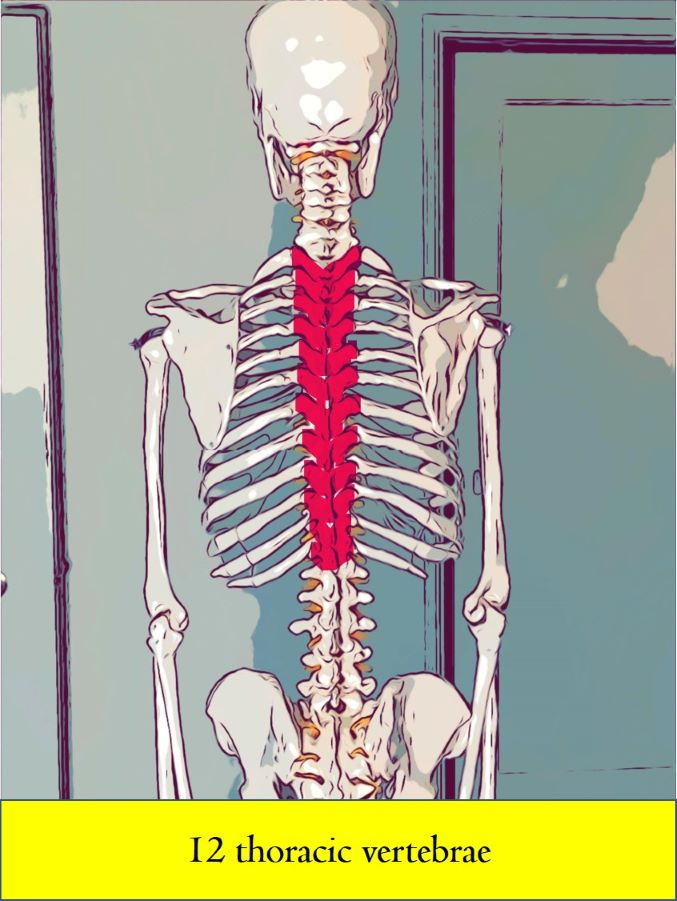
There are 12 thoracic vertebrae. The thoracic vertebrae are inside what we call the upper and middle back, and they span the length of the rib cage. As a group, the thoracic vertebrae (also called the thoracic spine) have an anatomical curve that creates a flexion of ~40° (called kyphosis). These vertebrae flex (~35°, in addition to the anatomical flexion), extend (~25°), and rotate (~30°). For the thoracic vertebrae, extension, in many cases, amounts to less anatomical flexion. The rib cage barrel has a bone-to-bone connection to the 33 vertebrae at T1 to T12.
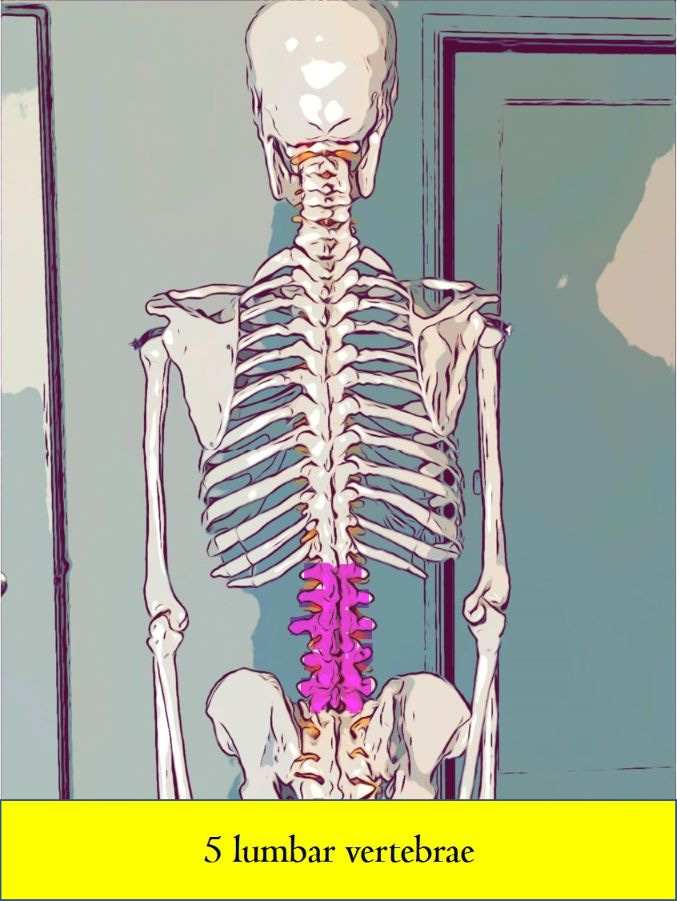
There are five lumbar vertebrae, and they are inside what we call the lower back. As a group, the lumbar vertebrae have an anatomical curve of ~40-60° into the body (lordosis). The lumbar vertebrae flex (~60°), which reduces the amount of anatomical curve into the body; flex to the side (~25°); extend (~25°); and rotate (~10°).
The sacrum, made up of the five fused vertebrae just below the lumbar vertebrae, and the tailbone, made up of four fused vertebrae just below the sacrum, are also part of the spinal column. Both have a fused kyphosis (an outward curve that creates a flexion). The pelvic barrel attaches to the 33 vertebrae at the sacrum.
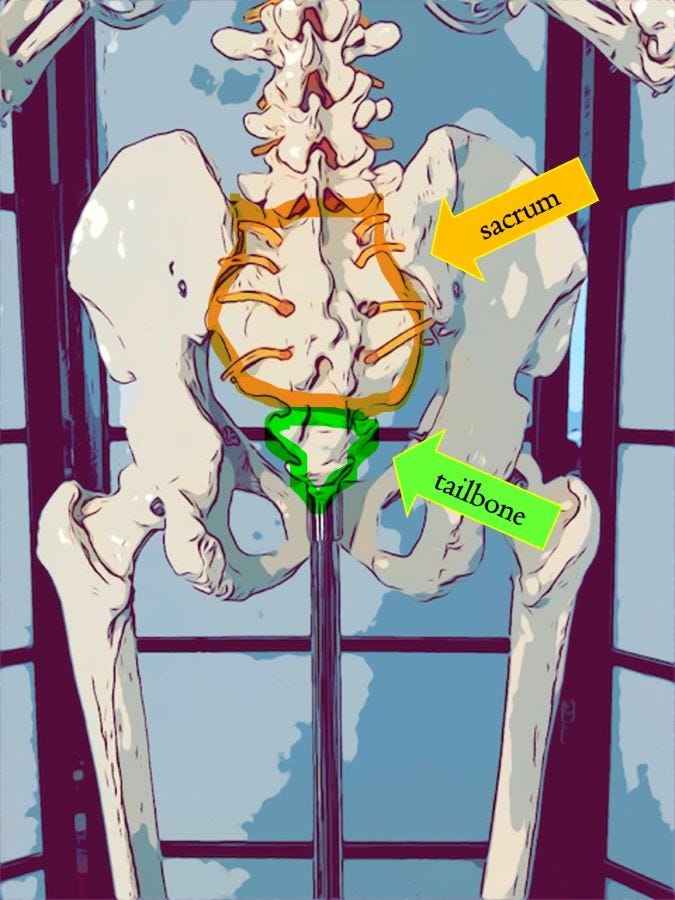
The meeting point of L5 and S1 forms the lumbosacral joint, which connects the lumbar spine to the sacrum; here, the anatomical curve of the vertebrae shifts from lordotic (the lumbar) to kyphotic (the sacrum). When the lumbar vertebrae flex, the sacrum and tailbone extend (curve under). When the lumbar vertebrae extend, the sacrum and tailbone flex (tilt up).
Including the sacrum and the tailbone, there are 33 vertebrae, shown again below.
* * *
Close your eyes and see the vertebrae in your own body. Start at C1 and move, vertebrae by vertebrae, to the tailbone. As you move down, see the skull, rib cage barrel, and pelvic barrel where they connect to the 33 vertebrae.
We all know how important alignment of the skull, rib cage barrel, and pelvic barrel is in being able to execute complicated movement. The fact that their movement begins at the vertebrae means that they are not cut off from each other – any misalignment impacts all alignment.
If your mind tells you to move the body in parts, you will move the body in parts, which means you will try to align the body in parts. If you can see all 33 vertebrae and the movement that begins there, you can begin to see the body as a unified body, or what I call a fusion body. Physical knowledge as basic as the understanding that the movement of the skull, the rib cage barrel, and the pelvic barrel begins at the vertebrae is the beginning of understanding the alignment of a fusion body.
It is important to see the skeleton underneath the muscle. The skeleton cannot exist as some vague notion you have about the body. When we dance, we are enlisting muscle to move bone. If we do not know what bone at rest looks like, how will we know when muscle is moving bone in and out of neutral? If we have no physical knowledge of the 33 vertebrae, how will we know where movement happens? If we have no physical knowledge of the 33 vertebrae, how will we understand how movement happens?
Make this your new mantra: Guesswork will not improve your technique.